
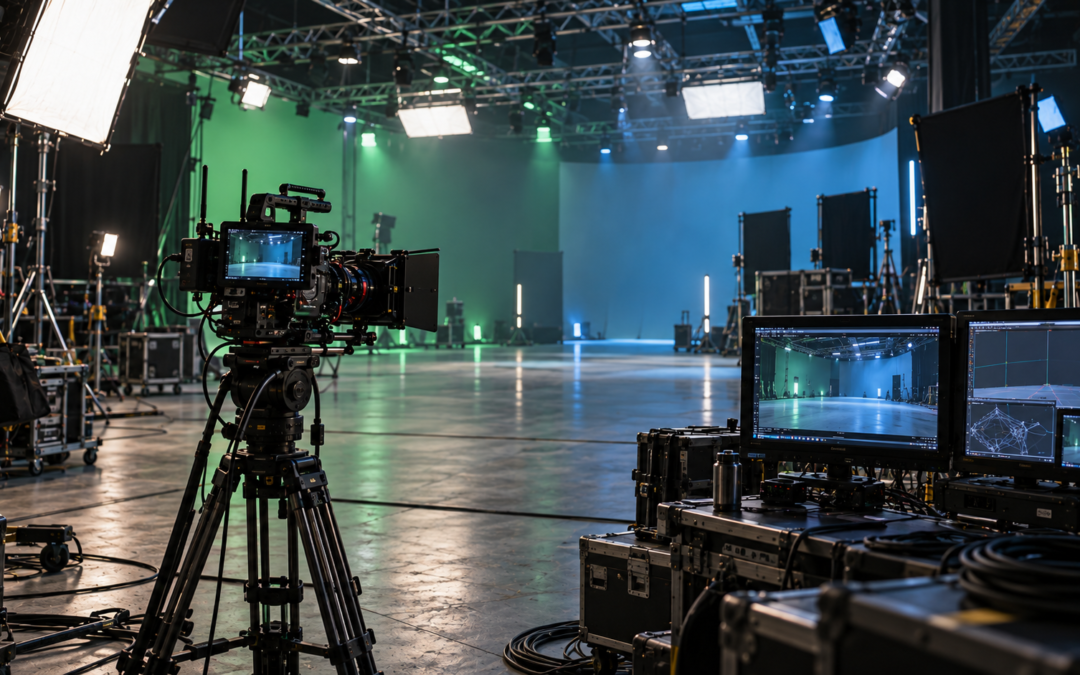
Virtual production is increasingly associated with large LED volumes, real-time rendering and camera tracking. These technologies can offer substantial advantages, but they do not make conventional green screen entirely obsolete, nor do they necessarily need to be adopted as a complete package.
There is a much broader range of possibilities: conventional chroma capture, green screen with camera tracking, projection, ordinary large displays, LED walls or full virtual-production stages. These techniques can also be combined. A production does not necessarily need to commit itself to one system for every shot.
Just as importantly, these approaches can occupy very different worlds of budget, preparation and technical complexity.
A useful starting point is therefore not simply which technology should we use, but what the shot actually requires, and what is the simplest reliable way of achieving it.
The technology should support the production method rather than determine it.
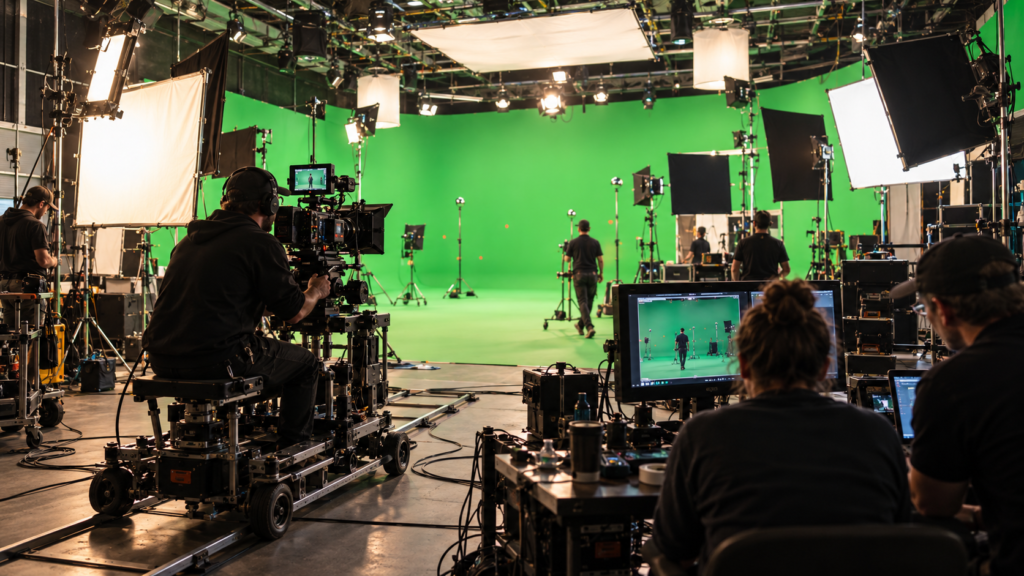
Green-screen production, illustrating how camera, lighting, monitoring and tracking equipment can form part of the same studio workflow.
Virtual Production Is Broader Than Just an LED Volume
Virtual production describes a range of techniques rather than one particular type of studio.
At one end, conventional green screen records the foreground separately and leaves the final environment to post-production. Camera tracking can add positional information so that a virtual camera follows the movement of the physical camera. Projection and large displays can place selected imagery physically on set. LED walls can provide backgrounds, reflections and environmental light, while a fully integrated virtual-production stage can combine LED display, camera tracking, real-time rendering, lens data and specialist control systems.
These approaches solve different problems:
| Approach | What it can add | What it can also involve |
| Conventional green screen | Clean separation of subject and background, with considerable freedom after filming | Keying, spill suppression, compositing and integration in post |
| Tracked green screen | Camera movement can drive a corresponding virtual viewpoint while retaining a chroma source | Tracking, lens calibration, coordinate alignment and real-time rendering |
| Projection / large display | A visible environment on set, useful for backgrounds, eyelines, reflections or environmental colour | Limits of screen size, brightness, viewing angle, resolution and camera movement |
| LED wall | A bright on-set background which can also contribute reflections and interactive light | Display cost, physical installation and possible camera artefacts |
| Full virtual-production stage | Camera-responsive environments and the possibility of bringing more of the finished image into principal photography | Greater preparation, infrastructure, specialist operation and technical integration |
None of these is automatically the more modern or more appropriate answer. Each moves work, cost and decision-making into a different part of the production.
The Budget May Decide Before the Technology Does
Technical comparisons can easily overlook a fairly consequential consideration: can the production realistically afford the proposed workflow?
Conventional green-screen studios can be available for hundreds of pounds per day, while more sophisticated LED and virtual-production stages can run into several thousand pounds per shooting day. Smaller LED installations and simpler playback systems occupy some territory between those extremes.
The studio rate is only part of the calculation. A virtual-production workflow may require digital environments to be prepared earlier, together with camera tracking, lens calibration, rendering and playback systems, specialist technical support and testing. Green screen moves some of that work elsewhere, particularly into keying, compositing and revisions.
For some productions the choice may be largely academic: a full virtual-production stage may simply sit outside the available budget. Understanding what it would have contributed is still useful, however, because it helps identify whether the particular benefit the shot needs can be achieved by a simpler method.
Conversely, an apparently expensive virtual-production workflow can make economic sense if it removes sufficient location work, travel, weather dependency, difficult shooting conditions or subsequent post-production.
The useful comparison is therefore not simply the cost of one studio against another, but where this particular production can most economically do the work.
Green Screen Buys a Particular Kind of Flexibility
One of the enduring advantages of green screen is that it allows some creative decisions to remain open after principal photography.
The final environment need not necessarily be complete when filming begins. Backgrounds can change between versions or territories, alternative treatments can be created from the same performance, and revisions need not automatically require the original cast, crew and studio to be reconvened.
That flexibility is not free.
Hair, motion blur, transparent materials and reflective objects can make keying more difficult. Green spill needs to be controlled. Foreground lighting still needs to make sense in relation to the eventual environment, as do perspective, colour and scale.
“We can change it later” is therefore not a substitute for careful photography. Green screen is most useful when the production genuinely benefits from keeping particular decisions open rather than simply postponing problems. This is one reason why the physical setup of a professional green screen video studio still matters.
When Green Screen Has a Limitation, LED Isn’t the Only Game in Town
LED technology can solve genuine production problems. Putting the environment physically behind the subject can provide interactive light and reflections, give performers something to see and, when combined with camera tracking and real-time rendering, allow perspective to respond to camera movement.
But identifying one of those requirements does not necessarily mean that a complete LED volume is required.
A highly reflective vehicle or product, for example, might justify a substantial LED environment because so much of its appearance is determined by what it reflects. A single polished object in close-up might need only a strategically positioned display, projection, conventional lighting or another controllable reflection source.
The objective is the required image, not the most sophisticated workflow available.
This leads to a more useful question than simply green screen or LED?
What problem are we actually trying to solve, and what is the simplest way of solving it?
Does Virtual Production Have to Be All or Nothing?
A fully equipped LED stage can make virtual production appear inaccessible to smaller studios and independent filmmakers. But the cost of a complete virtual-production facility should not be confused with the cost of beginning to explore virtual-production techniques.
A considerable proportion of the physical investment in a large stage lies in the display system itself. Once a large LED wall is no longer an essential part of the requirement, some of the underlying technologies become much more approachable.
A capable computer and graphics system, camera-tracking hardware and real-time rendering software still represent a significant investment, but one potentially measured in thousands rather than the considerably greater infrastructure behind a large LED stage.
That creates scope for real-time rendering and camera tracking to be used alongside conventional chroma capture, or for individual elements of a virtual-production workflow to be introduced only where they provide a useful benefit.
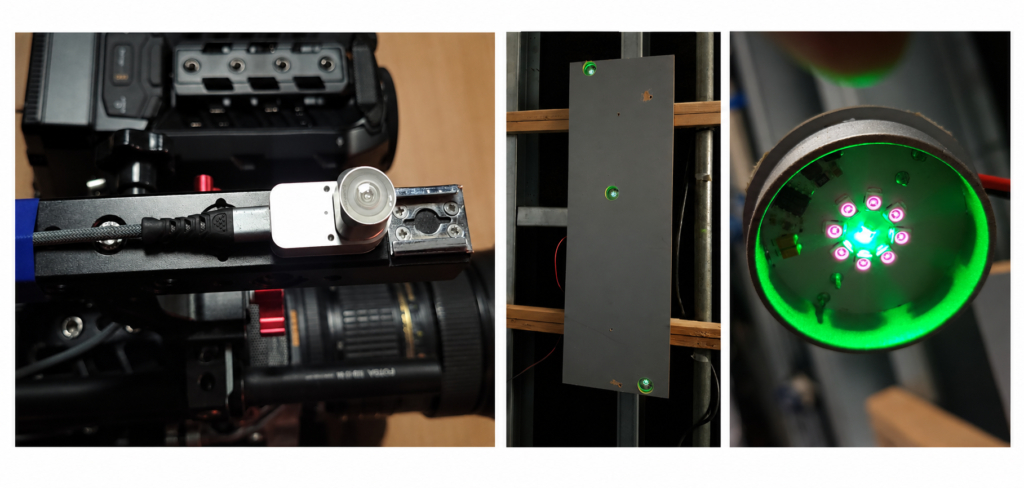
Camera tracking in practice: an Antilatency ALT tracker mounted on a camera, ceiling IR markers installed in the tracking area at Soundstage Studios, and a closer view of one marker. Although the tracking illumination is infrared and invisible to the eye, the camera can see the emitters surrounding the green status light.
None of this means that assembling the hardware makes the process easy. Tracking, lens calibration, coordinate alignment, rendering, latency and integration still require knowledge and testing. Simply owning the components is very different from having a dependable production workflow.
Nevertheless, an independent-filmmaking approach can make experimentation possible on a much more manageable scale: learn the individual parts, test them, improvise where appropriate and establish which pieces of the complete system a particular production genuinely needs.
Removing the LED wall does not make virtual production free, but it can change the scale of the investment dramatically.
Where Camera Tracking Fits with Green Screen
Camera tracking provides a useful example of how these technologies can be separated.
A tracking system records the physical camera’s position and orientation. That information can drive a corresponding virtual camera, allowing a rendered environment to change perspective as the real camera moves while the performer is still photographed against green.
This can help the production judge framing, movement, eyelines, scale and the relationship between foreground and virtual environment without requiring the background itself to be photographed from an LED display.
But tracking introduces its own possible failure points. Drift, inaccurate lens calibration, coordinate misalignment or latency can all undermine the apparent connection between the real and virtual cameras.
Real-time technology is therefore most valuable when seeing the result during production helps somebody make a decision that matters. Adding technology merely because it is available adds complexity without necessarily adding useful information.
Projection and Ordinary Displays Can Be Useful Too
Between green screen and a complete LED stage lies a much less glamorous but potentially useful category: ordinary displays and projection.
A large display can provide a visible background, an eyeline reference, reflections, environmental colour or simply something that allows performers, directors and clients to understand the intended scene while filming.
Projection offers another variation, although brightness, contrast, shadows, spill and projector placement introduce their own constraints.
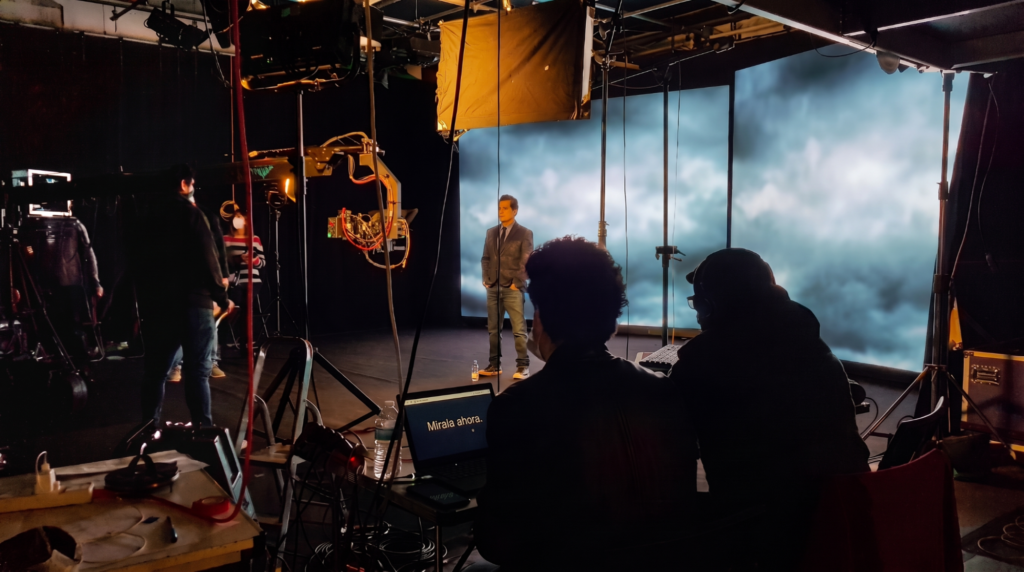
Display-based filming at Soundstage Studios, illustrating how video walls can provide an on-set background.
Neither technique automatically provides camera-responsive perspective. If the camera needs to move significantly through a three-dimensional virtual environment, tracking and real-time rendering may need to be added.
But not every shot requires that. A locked-off presenter against a distant environment poses a very different problem from a moving camera travelling through a virtual set.
There is little benefit in buying technical complexity that the shot cannot reveal.
Good Green Screen Still Depends on What Happens in the Studio
Whatever happens later, the quality of a green-screen result still depends heavily on the material captured on set.
- Separation between subject and background helps control spill.
- Lighting and exposure need to provide a usable chroma signal without unnecessarily contaminating the subject.
- Hair, transparent materials, reflective wardrobe and polished products deserve particular attention because they can complicate the eventual matte.
The detailed lighting methodology is better handled separately; Soundstage’s guide to lighting a green screen evenly covers exposure, false colour and practical ratios in more detail.
It is also worth remembering that the whole frame does not necessarily need to be green. Unused areas can often be masked in post, and practical foreground elements can sometimes solve problems more efficiently than trying to create everything digitally.
A green treadmill, for example, can allow a performer to appear to walk or run through an environment while remaining within a controlled chroma area. This is a slightly specialised requirement, perhaps, but a useful illustration of how an apparently digital production problem can sometimes have a straightforward practical solution.
For longer or multi-day productions, repeatability also matters. Camera settings, exposure, lighting and subject position need to remain sufficiently consistent to provide dependable material across the whole production.
For that reason, choosing a green screen studio in London is about more than simply finding a space with a green background. Lighting control, usable chroma coverage, camera movement, sound conditions and repeatability all affect the material delivered to post-production.
A Production Doesn’t Have to Pick One Technology Exclusively
Green screen and LED are not necessarily competing alternatives. Different shots within the same production may benefit from different approaches, and in some cases the technologies can instead complement each other.
One shot might benefit from conventional green screen because several backgrounds will be created later. Another might use a display because a reflective object needs something specific to reflect. A moving shot might justify camera tracking, while another may gain enough from a simple projected or displayed background without tracking at all.
Nor are these combinations limited to different ways of creating a background. Green screen can form part of a wider digital production workflow alongside other technologies. Motion capture, for example, can record a performer’s movement while chroma provides the separately replaceable environment. The two are solving different problems within the same production rather than competing to solve the same one.
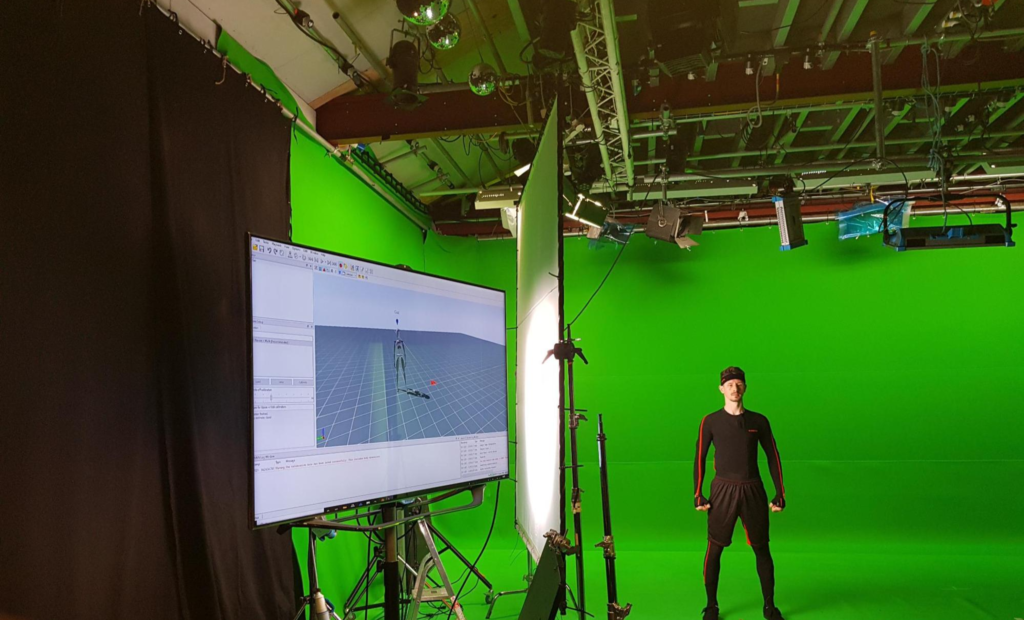
Motion capture in the green-screen studio at Soundstage. The performer and captured movement can be seen together, illustrating how chroma and motion capture can form different parts of the same digital production workflow.
Even placing a monitor outside the camera frame to provide a controlled reflection is, in a modest sense, a hybrid technique.
These are tools rather than competing philosophies. The sensible approach is to use as much technology as the shot needs, rather than as much as is available.
In a professional video production studio, that can also mean using different workflows for different shots within the same project.
Choosing the Simplest Reliable Workflow
In practice, choosing a workflow comes down to judgement rather than a checklist.
- What does the finished shot actually require?
- Which decisions need to be made during photography and which are better left open?
- What additional technology genuinely solves a problem, and where can the production most economically do the work?
Green screen production remains relevant because it is comparatively accessible, adaptable and well suited to productions that benefit from separating foreground capture from decisions about the final environment.
LED walls, projection, displays, camera tracking and real-time rendering can each add something valuable when the requirement justifies them. Increasingly, some of the constituent technologies associated with high-end virtual production can also be explored independently rather than only as part of a complete facility.
The important distinction is not between old and new technology. It is between technology that solves a production problem and technology that merely adds another one.