
At Soundstage Studios, bass guitar capture is approached as part of a wider performance workflow rather than a traditional recording process. The priority is not crafting a definitive bass sound in isolation, but capturing a stable, intelligible low end that translates reliably in the room, on camera, and through broadcast or livestream systems.
In practice, clear decisions made early in the setup and arrangement usually matter more than corrective fixes later. Performance-focused studio environments reduce uncertainty by providing controlled conditions, reliable signal paths, and monitoring that supports quick production decisions.
Decide the Role of the Bass Before You Plug In
Before microphones, DI boxes, or plug-ins enter the conversation, it helps to be clear about what the bass is doing in the performance.
| Bass role | Primary focus | Practical implication |
| Groove anchor | Low-end stability | Clean signal, controlled dynamics |
| Melodic voice | Note definition | Protect midrange clarity |
| Hybrid role | Balance | DI plus harmonic texture |
If the bass carries melodic information, clarity tends to matter most.
If it locks tightly with the drums, consistency and low-frequency control usually take priority.
Early arrangement decisions often reduce the need for corrective EQ later.
Prepare the Instrument for a Performance Session
Performance environments expose issues quickly. Preparation helps avoid disruption:
- stable tuning and intonation
- quiet electronics
- strings appropriate to the performance
- no unexpected level changes
Issues at the source tend to be harder, not easier, to manage later.
Bass and Kick: Make Space Early
Bass and kick interact closely, and muddy low end translates poorly on small speakers.
It’s usually more effective to make practical decisions early:
- decide which element owns the deepest low end
- Let the other occupy the upper bass or the low-mid range
- think in frequency ranges rather than exact numbers
A Reliable Capture Chain
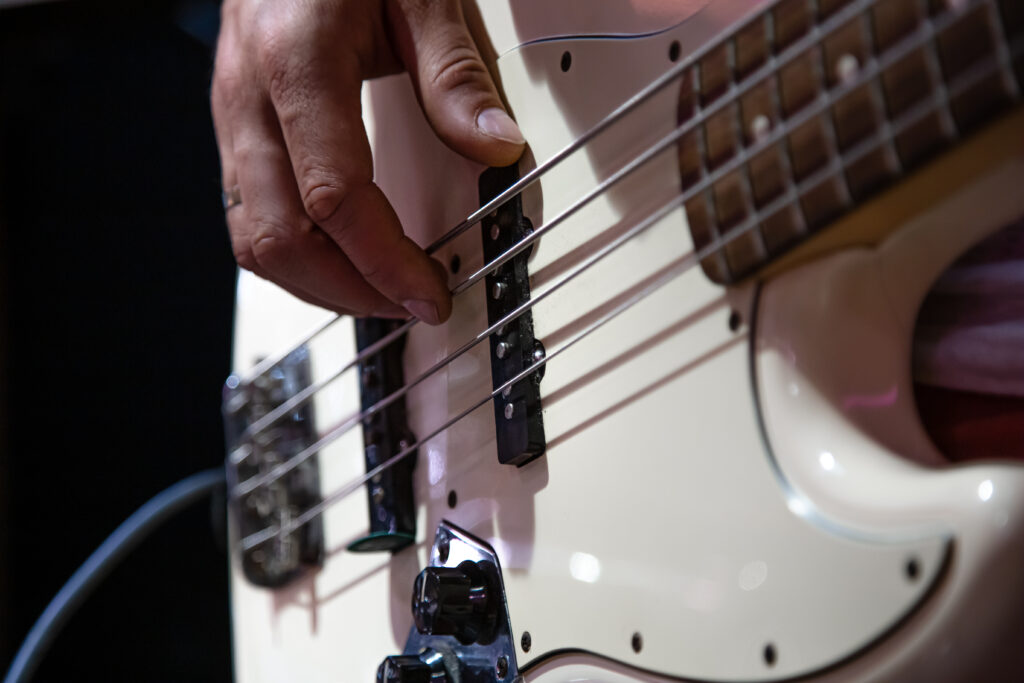
Bass → DI and/or amp → preamp → recorder / DAW / broadcast chain
Headroom is prioritised over pushing input levels to protect long takes and livestream delivery.
Why a DI Is Usually Captured?
A DI provides:
- timing and consistency reference
- a safety layer
- flexibility without slowing the session
Common Capture Approaches
- DI: speed, clarity, repeatability
- Mic’d amp: weight and harmonic texture
- DI + amp: security and tonal flexibility
When combining DI and amp, polarity and mono compatibility are checked so the low end reinforces rather than thins out.
Compression
Compression is used conservatively to support performance, not correct inconsistency.
Consistency Creates “Weight”
A consistent bass often feels bigger than a louder one.
Common Problems and Practical Responses
| Issue | Likely cause | Practical response |
| Hum or buzz | Power/grounding | Shared, stable power |
| Hollow low end | Phase cancellation caused by signal delay or polarity differences between DI and mic signals | Check polarity and align signals |
| Muddy tone | Mic placement or overlap | Adjust placement or bass/kick balance |
| Clipping | Excessive source level | Restore headroom |
Most issues are better prevented through capture decisions than cured later with plug-ins.
Typical Scenarios
- Tour rehearsals: DI + amp, repeatable results
- Filmed performance: DI security, amp texture
- Livestream: attention to phone/laptop playback, mono compatibility, and stable levels
Final Checks
- tune before takes
- confirm bass role
- maintain headroom
- capture DI
- adjust mic before EQ
- Check polarity in mono
Bass Capture That Holds Up
Reducing uncertainty early helps rehearsals run smoothly, filmed takes hold together, and livestreams translate reliably.
Contact Soundstage Studios to discuss your project or arrange a visit.